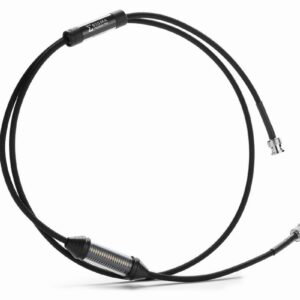
Sigma Series cables showcase technological innovation and design execution that simply does not exist elsewhere — at any price. Sigma Series cables combine meaningful parts innovations with objective measurement and an artisan’s eye for construction quality. Unlike many cost-no-object cable products that have little in the way of discernible science, Sigma Series products incorporate an array of definable technologies that sets the standard for quality and performance in the cable industry.
Sigma digital cables feature Shunyata Research’s exclusive patent-pending TAP Polarizer technology. TAP reduces electromagnetic polarization distortion. Ohno Continuous Cast Copper and PMZ conductors with exotic fluorocarbon dielectrics make for a true reference quality digital cable.
Standard length of cable is 1 meter.
High-speed digital transmission is very different from audio frequency signal transmission and requires a different knowledge base and design criteria. Audio cable signal transmission is governed by the principles of inductance, capacitance, and resistance. By contrast, high-speed digital signals are governed by a principle known as ‘transmission line theory’.
The performance of a transmission line is governed by the characteristic impedance of the cable. Certain types of cable require a specific characteristic impedance to achieve optimal performance — for instance, cable TV coaxial cables are 75 ohms, while test equipment cables require 50 ohm cables. Modern audio and entertainment systems may have multiple digital connections, each with potentially different characteristic impedances.
While the characteristic impedance is a critical factor in the optimal performance of digital cables, our research also indicates that the precision with which a digital cable is constructed has a significant impact on its performance.
Shunyata Research digital cables are produced using a Precision Matched Z concept. This dictates that tolerances of the conductor surface, dielectric extrusion, and the precision of the braided shield are held to smaller variances. To achieve these tight tolerances, the extrusion and braiding machines must be run at one-quarter speed during the manufacturing process. The result is better performance through a reduction of cable-induced ‘signal jitter’.
Superficially, digital cables may look the same as analog cables. For example, a S/PDIF cable can be terminated with RCA connectors, much like analog interconnects. Because the terminations appear the same, analog interconnects could be used as a substitute for a digital cable; but since it has not been designed with the correct characteristic impedance, the performance will suffer.
Shunyata Research digital cables are produced using a Precision Matched Z (PMZ) concept. This means that tolerances of the conductor surface, dielectric extrusion, and the precision of the braided shield are held to minute variances. To achieve these tight tolerances, the extrusion and braiding machines must be run at one-quarter speed during the manufacturing process. The result is better performance through a reduction of cable-induced ‘signal jitter’. (Note: Z means impedance)
TAP (Transverse Axial Polarizer) is a device that interacts with the electromagnetic field generated by the signal traveling along the signal cable. TAP improves the sonic performance of the cable by modifying the behavior of the electromagnetic wave that surrounds the signal cable. In effect, the TAP blocks longitudinal-oriented waves while passing transverse-oriented waves. The effect in sonic terms is like using polarized sunglasses to reduce reflected sunlight. Correcting polarization micro-distortion reduces what some call sonic glare. ~ Patent Pending ~
KPIP™ (Kinetic Phase Inversion Process) was developed by Caelin Gabriel after years of research into the underlying causes of various effects such as burn-in, wire directionality and the effects of cryogentic treatment. He discovered that there was an underlying core principle that burn-in and cryogenics only “partially” addressed. Once the governing principle was understood it became possible to create a processing technique and machine that could virtually eliminate the need for burn-in and cryogenic treatment.
ArNi® is a type of wire created by Shunyata Research designed to be the finest quality wire available for audio purposes. It begins with the highest purity of copper available – OFE C10100 or Ohno (single crystal). Then it is formed in virtual hollow tubes eliminating skin effects and eddy current distortions. In addition, the wire undergoes our proprietary KPIP™ process.
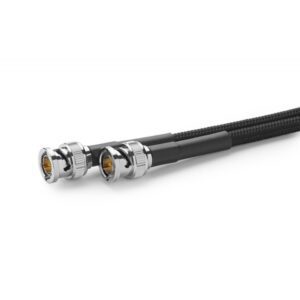
| Cable: 75-ohm coaxial PMZ, FEP dielectric, silver-plated braided shielding |
| Termination: True 75-ohm BNC compression connectors |
| Characteristic Impedance: 75-ohm |
Marca
SHUNYATA RESEARCH
Shunyata Research es una de las marcas de referencia mundial en soluciones de alimentación eléctrica para sistemas de audio High-End.
Desde Estados Unidos desarrolla acondicionadores de red, distribuidores de corriente y tecnologías avanzadas diseñadas para reducir ruido eléctrico y mejorar el rendimiento de sistemas de reproducción musical de máxima exigencia.
Sound Sevilla ofrece Shunyata Research en España, integrando sus soluciones en sistemas de audio High-End, salas de escucha dedicadas y proyectos audiovisuales premium.

La alimentación eléctrica es un elemento fundamental en cualquier sistema High-End. Shunyata Research desarrolla productos diseñados para optimizar la entrega de energía y conseguir mayor silencio de fondo, dinámica y transparencia sonora.En Sound Sevilla seleccionamos Shunyata Research para instalaciones donde cada detalle cuenta, combinándola con electrónica, fuentes digitales, cableado y sistemas de referencia.